Fantastic NSK300 Updated Test Cram - Easy and Guaranteed NSK300 Exam Success
Wiki Article
What's more, part of that ExamsLabs NSK300 dumps now are free: https://drive.google.com/open?id=1fAsmBLGahh7C8looP0NB7vh0OCCbj4lp
As you know the registration fee for the Netskope Certified Cloud Security Architect (NSK300) certification exam is itself very high, varying between 100$ and 1000$. And after paying the registration fee for better preparation a candidate needs budget-friendly and reliable Netskope Certified Cloud Security Architect (NSK300) pdf questions. That is why ExamsLabs has compiled the most reliable updated Netskope NSK300 Exam Questions with up to 1 year of free updates. The Netskope NSK300 practice test can be used right after being bought by the customer and they can avail of the benefits given in the Netskope Certified Cloud Security Architect (NSK300) pdf questions.
The emerging Netskope field creates a space for Netskope Certified Cloud Security Architect (NSK300) certification exam holders to accelerate their careers. Many unfortunate candidates don't get the Netskope Certified Cloud Security Architect (NSK300) certification because they prepare for its Netskope Certified Cloud Security Architect (NSK300) exam questions from an Netskope NSK300 exam that dumps outdated material. It results in a waste of time and money. You can develop your skills and join the list of experts by earning this Netskope Certified Cloud Security Architect (NSK300) certification exam.
>> NSK300 Updated Test Cram <<
NSK300 Test Simulator Online, Pdf NSK300 Dumps
Our NSK300 practice questions and answers are created according to the requirement of the certification center and the latest exam information. Our NSK300 real dumps cover the comprehensive knowledge points and latest practice materials that enough to help you Clear NSK300 Exam tests. You will get our valid NSK300 dumps torrent and instantly download the exam pdf after payment.
Netskope NSK300 Exam copyright Topics:
| Topic | Details |
|---|---|
| Topic 1 |
|
| Topic 2 |
|
| Topic 3 |
|
| Topic 4 |
|
| Topic 5 |
|
Netskope Certified Cloud Security Architect Sample Questions (Q20-Q25):
NEW QUESTION # 20
Review the exhibit.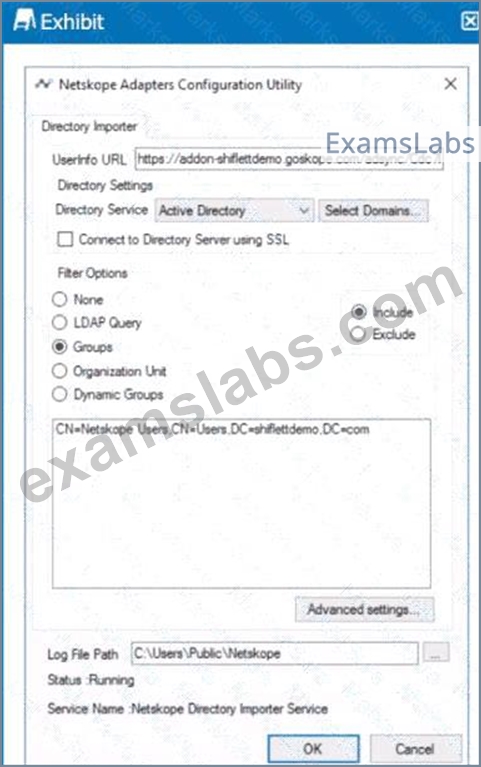
You installed Directory Importer and configured it to import specific groups ot users into your Netskope tenant as shown in the exhibit. One hour after a new user has been added to the domain, the user still has not been provisioned to Netskope.
What are three potential reasons for this failure? (Choose three.)
- A. Directory Importer does not support ongoing user syncs; you must manually provision the user.
- B. Active Directory integration is not enabled on your tenant.
- C. The user is not a member of the group specified as a filter
- D. The server that the Directory Importer is installed on is unable to reach Netskope's add-on endpomt.
- E. The default collection interval is 180 minutes, therefore a sync may not have run yet.
Answer: C,D,E
Explanation:
The three potential reasons for the failure of a new user not being provisioned to Netskope an hour after being added to the domain could be:
* B. The server that the Directory Importer is installed on is unable to reach Netskope's add-on endpoint:
If the server cannot connect to Netskope's endpoint, it cannot sync the user data. This could be due to network issues, incorrect configuration, or firewall restrictions1.
* C. The user is not a member of the group specified as a filter: The Directory Importer may be configured to import users from specific groups only. If the new user is not a member of these groups, they will not be imported into Netskope1.
* E. The default collection interval is 180 minutes, therefore a sync may not have run yet: The Directory Importer may be scheduled to sync every 180 minutes. If only an hour has passed, the sync process might not have occurred yet, and the user would not be provisioned until the next sync interval1.
These potential reasons are based on the standard operation and configuration of the Netskope Directory Importer as described in the Netskope Knowledge Portal and documentation
NEW QUESTION # 21
A company needs to block access to their instance of Microsoft 365 from unmanaged devices. They have configured Reverse Proxy and have also created a policy that blocks login activity for the AD group "marketing-users" for the Reverse Proxy access method. During UAT testing, they notice that access from unmanaged devices to Microsoft 365 is not blocked for marketing users.
What is causing this issue?
- A. The username in the name ID field is not in the format of the e-mail address.
- B. The username in the name ID field does not have the "marketing-users" group name.
- C. There is a missing group name in the SAML response.
- D. There is an invalid certificate in the SAML response.
Answer: C
Explanation:
The issue is likely caused by a missing group name in the SAML response (A). When access to Microsoft 365 from unmanaged devices is not blocked as expected, despite having a policy in place, it often indicates that the SAML assertion is not correctly identifying the user as a member of the restricted group. In this case, the "marketing-users" group name should be present in the SAML response to enforce the policy that blocks login activity for this group. If the group name is missing, the policy will not apply, and users will not be blocked as intended.
NEW QUESTION # 22
Review the exhibit.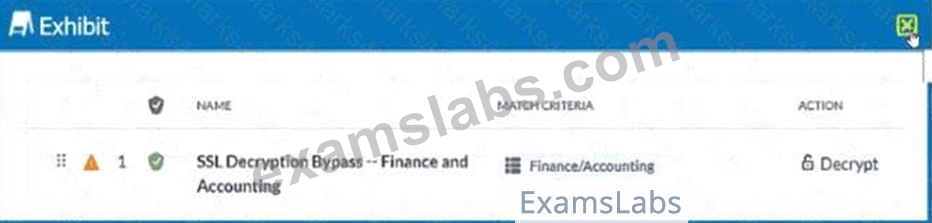
You created an SSL decryption policy to bypass the inspection of financial and accounting Web categories.
However, you still see banking websites being inspected.
Referring to the exhibit, what are two possible causes of this behavior? (Choose two.)
- A. An incorrect action has been specified.
- B. The policy is in a "pending changes" state.
- C. An incorrect category has been selected
- D. The policy is in a "disabled" state.
Answer: A,B
NEW QUESTION # 23
You are troubleshooting an issue with users who are unable to reach a financial SaaS application when their traffic passes through Netskope. You determine that this is because of IP restrictions in place with the SaaS vendor. You are unable to add Netskope's IP ranges at this time, but need to allow the traffic.
How would you allow this traffic?
- A. Use Explicit Proxy Over Tunnel (EPoT) so the traffic will egress from the corporate data center.
- B. Use Cloud Explicit Proxy so the traffic will egress from the corporate data center
- C. Use an IPsec tunnel to forward traffic so it will egress from the corporate data center
- D. Use NPAto implement Source IP anchonng so the traffic will egress from the corporate data center.
Answer: B
Explanation:
To allow traffic to a financial SaaS application that is being blocked due to IP restrictions, the best option is to use Cloud Explicit Proxy. This method allows traffic to egress from the corporate data center without requiring Netskope's IP ranges to be added to the SaaS vendor's allowlist. By configuring an allowlist in the Cloud Explicit Proxy settings, you can add any source egress IP addresses for your on-premises users, and Netskope will allow the traffic from the added user and IP address without authenticating1.
NEW QUESTION # 24
Your company purchased Netskope's Next Gen Secure Web Gateway You are working with your network administrator to create GRE tunnels to send traffic to Netskope Your network administrator has set up the tunnel, keepalives. and a policy-based route on your corporate router to send all HTTP and HTTPS traffic to Netskope. You want to validate that the tunnel is configured correctly and that traffic is flowing.
In this scenario, which two statements are correct? (Choose two.)
- A. You can use your local router or network device to verify that keepalives are being received and traffic is flowing to Netskope.
- B. You can verify that the tunnel is up in the Netskope Trust portal at https://trust netskope.com/.
- C. You must use your own monitoring tools to verify that the tunnel is up.
- D. You can verify that the tunnel is up and receiving traffic in the Netskope Ul under Settings > Security Cloud Platform > GRE.
Answer: A,D
Explanation:
To validate that the GRE tunnel is configured correctly and that traffic is flowing to Netskope, the correct statements are:
A: You can use your local router or network device to verify that keepalives are being received and traffic is flowing to Netskope. This is a standard method for checking the health and activity of a GRE tunnel.
C: You can verify that the tunnel is up and receiving traffic in the Netskope UI under Settings > Security Cloud Platform > GRE. This is a feature provided by Netskope to monitor the status of GRE tunnels directly from the Netskope interface12.
Statement B is incorrect because Netskope provides its own tools for monitoring the status of the tunnel. Statement D is incorrect because the Netskope Trust portal provides information on the overall service status and updates, not specific tunnel status3.
NEW QUESTION # 25
......
When people take the subway staring blankly, you can use Pad or cell phone to see the PDF version of the NSK300 study materials. While others are playing games online, you can do online NSK300 exam questions. We are sure that as you hard as you are, you can Pass NSK300 Exam easily in a very short time. While others are surprised at your achievement, you might have found a better job.
NSK300 Test Simulator Online: https://www.examslabs.com/Netskope/Netskope-NCCSA/best-NSK300-exam-dumps.html
- Exam NSK300 copyright ???? Exam NSK300 copyright ???? Download NSK300 Demo ???? Search for 「 NSK300 」 and easily obtain a free download on ( www.vceengine.com ) ????Certification NSK300 Training
- NSK300 Updated Test Cram Exam | Best Way to Pass Netskope NSK300 ???? Easily obtain ✔ NSK300 ️✔️ for free download through ⮆ www.pdfvce.com ⮄ ????Question NSK300 Explanations
- Netskope NSK300 Questions - Latest Approved Exam Dumps ???? Open ➡ www.practicevce.com ️⬅️ and search for ▛ NSK300 ▟ to download exam materials for free ????Certification NSK300 Training
- Test NSK300 Valid ???? Question NSK300 Explanations ???? Valid NSK300 Test Duration ???? Search for ➥ NSK300 ???? and download it for free on ➤ www.pdfvce.com ⮘ website ????NSK300 Premium Exam
- Pass Netskope NSK300 Exam with flying colors ???? The page for free download of 《 NSK300 》 on [ www.examcollectionpass.com ] will open immediately ????Question NSK300 Explanations
- Quiz 2026 NSK300: High-quality Netskope Certified Cloud Security Architect Updated Test Cram ???? Search on ☀ www.pdfvce.com ️☀️ for “ NSK300 ” to obtain exam materials for free download ☯Sample NSK300 Questions
- NSK300 Exam Dump ???? Test NSK300 Valid ???? Valid NSK300 Test Preparation ☑ Search for “ NSK300 ” and easily obtain a free download on ⮆ www.prep4away.com ⮄ ????Sample NSK300 Questions
- Exam NSK300 copyright ???? Test NSK300 Valid ???? NSK300 Exam Dump ⚖ Search for ☀ NSK300 ️☀️ and download exam materials for free through ⮆ www.pdfvce.com ⮄ ????Valid NSK300 Test Duration
- NSK300 Detailed Study Dumps ???? NSK300 Premium Exam ???? Test NSK300 Engine ⬜ Open website ☀ www.exam4labs.com ️☀️ and search for 《 NSK300 》 for free download ????NSK300 Pass Test
- NSK300 Pass Test ???? Exam NSK300 copyright ???? Download NSK300 Demo ???? Simply search for ( NSK300 ) for free download on ✔ www.pdfvce.com ️✔️ ????Test NSK300 Engine Version
- NSK300 Reliable Test Online ???? NSK300 Pass Test ???? Valid Dumps NSK300 Ebook ???? Easily obtain ➤ NSK300 ⮘ for free download through ▷ www.dumpsquestion.com ◁ ????Download NSK300 Demo
- deannacxwu704460.eveowiki.com, keithqesn764047.anchor-blog.com, kianawcre612156.activablog.com, maciespvs098544.bloggip.com, socialwebnotes.com, bookmarkeasier.com, mollygnup981026.mywikiparty.com, aadamqedi760666.webdesign96.com, bookmarkcitizen.com, bookmarkdistrict.com, Disposable vapes
2026 Latest ExamsLabs NSK300 copyright and NSK300 copyright Free Share: https://drive.google.com/open?id=1fAsmBLGahh7C8looP0NB7vh0OCCbj4lp
Report this wiki page